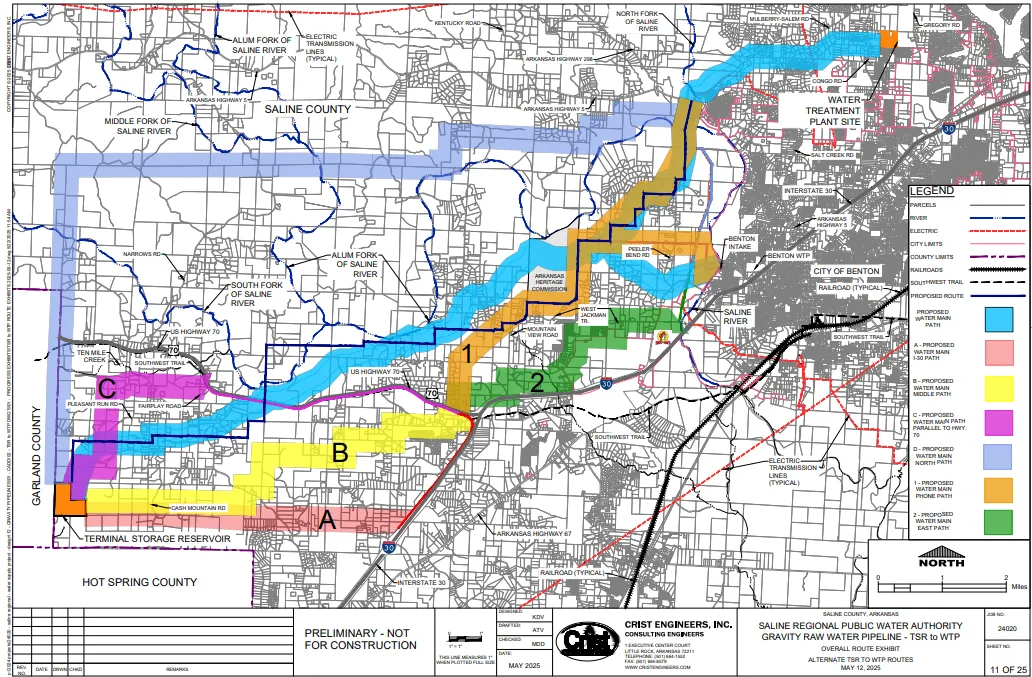
Project map courtesy of the Saline Regional Public Water Authority
Saline County is getting a new regional water system. The Saline Regional Public Water Authority is building a pipeline that will carry water from the Ouachita River through private land across the county, and if that pipeline crosses your property, the decisions you make in the next few months could significantly affect what you are paid and what happens to your land for decades to come.
At its core, the project involves building an intake structure on the Ouachita River, transporting raw water into Saline County, constructing a water treatment plant, and then running treated water to member water systems throughout the county. The SRPWA's current plan calls for a 35-inch diameter waterline, a significant pipeline that will require permanent easements across private land.
Communities expected to draw from this system include Benton, Bryant, East End, Haskell, and Shannon Hills. The project is designed to serve nearly 100,000 Saline County residents and is intended to address the county's growing water demands for years to come.
This is not a small or temporary project. The waterline and the easements that come with it will be permanent features on the land they cross.
The Saline Regional Public Water Authority (SRPWA) is now in active easement acquisition and design, the phase where property owners are being approached and agreements are being signed. The project received a $7.7 million state loan in late 2025 as part of Governor Sanders' statewide water infrastructure package, and it has been in planning for several years.
The most fundamental right you have is the right to be paid fairly. Arkansas law requires just compensation for any property taken or damaged through condemnation. "Just compensation" is defined in Arkansas as the fair market value of the property taken — but what the condemning authority initially offers you is almost never the full measure of what you are actually owed.
When a public or quasi-public entity acquires an easement across your land, you are entitled to:
Under Arkansas law, when a corporation, including a water authority, is the condemning entity, you are entitled to the value of the property taken plus any diminution in value to your remaining property, regardless of any benefit the project may bring to your land. All determinations of just compensation in Arkansas are ultimately decided by a jury at trial if the parties cannot agree.
The first offer you receive is a starting point, it is not the final word. Condemning authorities typically make low initial offers, and many landowners accept them without realizing they could have received significantly more. You have the right to reject the initial offer and negotiate for a higher amount.
If an agreement cannot be reached, the condemning authority must file a condemnation lawsuit in circuit court. At that point, the authority deposits money with the court, typically based on its own appraisal, and the court may allow it to proceed with construction while the compensation dispute is resolved. You are entitled to receive that deposited amount immediately, even while the litigation continues.
This is one of the most important, and least understood, rights in Arkansas condemnation law. Under a 2015 legislative change, if a jury awards you compensation that exceeds the amount the condemning authority deposited with the court by ten percent (10%) or more, you may be entitled to recover your attorney's fees, appraisal costs, and expert witness fees from the condemning authority. This provision now applies to public utilities and improvement districts, not just the State Highway Department.
In plain terms: if you hire an attorney and a qualified appraiser, fight for full compensation, and win a significantly better result at trial, the authority may have to pay your legal costs. This is a powerful protection that levels the playing field.
Your rights do not stop at compensation. The easement agreement itself, which is the legal document that will permanently govern what the authority can do on your land, is negotiable. Before you sign anything, an attorney should carefully review the proposed easement for provisions addressing:
Once you sign an easement, you are bound by its terms, often permanently. Negotiating those terms carefully before signing is just as important as negotiating the price.
If the proposed easement location is particularly burdensome, for example, if it bisects your property in a way that severely limits its use, or if it runs too close to your home, well, or outbuildings, you have the right to propose an alternate route across your property. While you cannot force the authority to accept your proposal, a well-documented alternative that reduces damage to your land can be a valuable negotiating tool.

If you have been approached about an easement for the Saline County waterline project, or if you believe the project may cross your property, here is what you should do:
Our firm represents Saline County landowners in easement negotiations and condemnation proceedings. We understand Arkansas eminent domain law, and we know how to fight for full compensation, not just what the authority puts on the table first.
If the Ouachita River waterline project may affect your property, contact our office today for a consultation. There is no cost to talk, and you may have more rights than you think.
This post is provided for general informational purposes and does not constitute legal advice. Every landowner's situation is different. Contact our office to discuss the specific facts of your case.
DISCLAIMER: This blog post is for general informational purposes only and does not constitute legal advice. Reading this post does not create an attorney-client relationship. Contact our office directly to discuss your specific situation.